

Timeline of Changes & Benefits within a Sauna Session
What happens within your body during a sauna session. We know it induces a mild fever like state that is suggested to make it a powerful detoxifying agent with numerous immune system and health benefits, but research has enabled us to know a lot more specifics of what is going on internally.
Assuming a healthy adult in a traditional dry sauna for about 15-20 minutes at roughly 70-100°C with low humidity, here is the likely timeline. Exact timing varies with temperature, humidity, hydration, body size, heat acclimation, and health status.
Note that the traditional Finnish sauna at Sublime Health Club is typically 80-85 degrees, and rarely, if ever, above 90 degrees.
Timeline within one session
Before entry - Baseline heart rate, blood pressure, temperature, and hydration determine tolerance. Starting hydrated reduces dizziness and excessive cardiovascular strain.
0-3 minutes - Skin temperature rises rapidly. Skin blood vessels begin dilating, shifting more blood toward the surface. You feel warmth quickly; muscles and joints may begin to feel less stiff.
3-8 minutes - Sweating begins or accelerates. Heart rate and cardiac output rise to maintain blood pressure while skin circulation increases. Heat dissipation increases. Warmth may produce a subjective sense of comfort or relaxation.
8-15 minutes - Sweating becomes substantial. Heart rate continues rising; reviews report that it can reach 120-150 beats/min under sufficiently hot or prolonged conditions. Core temperature begins rising, although the size of the increase varies.Temporary increases in circulation and tissue temperature may reduce perceived stiffness. This cardiovascular response resembles some aspects of exercise, but sauna does not reproduce muscular work or all exercise adaptations. Mayo Clinic Proceedings
15-20 minutes - Heat storage, skin blood flow, sweating, thirst, and cardiovascular load approach their session peak. Fluid loss reduces plasma volume; stress-related hormones such as norepinephrine may rise.The acute vascular stimulus is strongest, but so is the risk of dehydration, low blood pressure, nausea, or fainting. More time is not necessarily more beneficial.
20-30 minutes - This exceeds a typical single uninterrupted session for many users, though it has been studied under controlled conditions. A 30-minute session at 73°C reduced blood pressure and arterial stiffness immediately afterward in adults with cardiovascular risk factors. These group averages do not establish that 30 minutes is ideal or safe for everyone. PubMed. Given the sauna at Sublime Health Club is typlically 80-85 degress celcius, this finding is not applicable, so we recommend that individual sessions are limited to 20 minutes, although it is fine to do another sauna session after a 5 minute break outside, in the ocean, a cold shower or ice bath.
The sequence above is a physiological reconstruction rather than a precisely validated minute-by-minute schedule. Research usually measures participants before, during, immediately after, and during recovery rather than every minute.
After leaving
First 0-10 minutes
Skin blood vessels remain dilated, and your body continues shedding stored heat. Heart rate may remain elevated while blood pressure can fall, especially when standing abruptly.
This is when light-headedness or fainting may occur. Sit down, cool gradually, and drink according to thirst. A cold plunge produces an additional abrupt cardiovascular response and should not be treated as a required part of the benefit.
Around 10-30 minutes
Heart rate and temperature trend back toward baseline, while sweating declines. In one study, blood pressure after a 30-minute sauna fell from an average of 137/82 to 130/75 mmHg, and systolic pressure remained below baseline after 30 minutes of recovery. Sodium and potassium did not significantly change, although creatinine rose slightly, consistent with acute fluid shifts. PubMed
Autonomic activity also begins normalizing. In a study of 93 adults with cardiovascular risk factors, most heart-rate-variability measures approached baseline during 30 minutes of recovery, and average resting heart rate was lower at the end of recovery than before the sauna. Complementary Therapies in Medicine
Around 30-60 minutes
With cooling and fluid replacement, circulation and thermal balance continue normalizing. Subjective relaxation may persist, but the duration and magnitude of this effect are difficult to quantify.
Any immediate drop on the scale is mainly water loss, not fat loss. Rehydration restores most of it.
What one session can plausibly provide
Evidence supports these acute effects:
Greater skin blood flow and cardiac output
Higher heart rate and sweating
Temporary warming of skin and other tissues
Temporary reduction in blood pressure for some people
Temporary reduction in arterial stiffness
Changes in autonomic nervous-system activity during recovery
Possible short-term relaxation and reduced perception of stiffness
Heat activates thermoregulatory and autonomic pathways, increasing heart rate, skin circulation, cardiac output, and sweating. Systematic review
Practical safety limits
For a healthy beginner, a conservative session is 5-10 minutes, increasing gradually only if well tolerated. Many traditional sessions last 5-20 minutes, but comfort and symptoms matter more than reaching a target duration. Mayo Clinic Proceedings
Leave immediately for dizziness, nausea, weakness, confusion, headache, chest discomfort, unusual breathlessness, or palpitations. Avoid combining sauna with alcohol, dehydration, fever, or acute illness. People who are pregnant or who have unstable heart disease, severe valve disease, poorly controlled blood pressure, recurrent fainting, significant kidney disease, or medications that impair blood pressure or fluid regulation should obtain individualized medical guidance.

Expected Time Frame of Changes & Benefits from Sauna Therapy
If you’re considering adding sauna therapy to your health and wellness routine, here’s what you can expect in terms of changes to your body, and both short and long-term benefits from regular sauna therapy based on research findings - 2-3 time per week at least.
A realistic expectation is: immediate relaxation and cardiovascular effects after one session, heat adaptation after about 2-3 weeks, and measurable blood-pressure or vascular changes after roughly 4-8 weeks of consistent use. Longer-term disease-prevention claims remain associations, not proven treatment effects.
Expected timeline
During one session - More sweating, faster heart rate, increased skin blood flow, and temporary fluid loss.
Within 30-60 minutes - Relaxation and, in some people, a temporary reduction in blood pressure; dizziness can also occur.
That evening - Many people report easier sleep or less muscle tension.
1-2 weeks - Better tolerance of the heat and possibly fewer symptoms in certain supervised clinical populations.
2-3 weeks - Earlier sweating, improved temperature regulation, and a lower heart-rate strain during heat; athlete studies commonly use about 10 sessions over 3 weeks when using sauna post exercise for adaptation to high temperatures.
4-8 weeks - Potential reductions in resting blood pressure and improvements in blood-vessel function.
8-12 weeks - Possible improvements in pain, quality of life, or exercise capacity in selected populations, although findings vary considerably.
Years of habitual use - Frequent sauna use is associated with lower cardiovascular and all-cause mortality in Finnish cohorts.
A meta-analysis of passive-heat interventions lasting 10-36 sessions found average reductions of approximately 4 mmHg in systolic and diastolic blood pressure, along with improved flow-mediated dilation. The studies used several forms of heat therapy, however, so the estimates cannot be attributed entirely to sauna bathing. PubMed
In trained runners, approximately 10 post-exercise sauna exposures over three weeks produced most of the observed heat-acclimation and performance adaptations; extending treatment to seven weeks added little. This is most applicable to trained athletes rather than the general population. PMC
A reasonable trial period
Assuming you are a healthy adult:
Week 1: Use the sauna 2-3 times, starting with 5-15 minutes per session.
Weeks 2-4: If well tolerated, progress to 10-20 minutes, 2-4 times weekly.
Weeks 5-8: Maintain a consistent routine and assess one specific outcome, such as home blood pressure, pain, sleep quality, or perceived recovery.
At eight weeks: If there is no meaningful benefit for your chosen outcome, more exposure is not guaranteed to help.
Traditional Finnish-sauna evidence generally involves temperatures near 80°C, so results should not automatically be transferred to lower-temperature infrared saunas. Reviews also emphasize that the clinical studies are heterogeneous and often small; one systematic review identified 40 studies but only 13 randomized trials. Mayo Clinic Proceedings PubMed
Safety
Stop the session and cool down if you develop dizziness, nausea, unusual weakness, headache, chest discomfort, or palpitations. Avoid alcohol around sauna use, replace fluids, and do not rely on aggressive sauna-to-ice-water transitions if you have cardiovascular risks.
Because this can affect blood pressure and hydration, consult a clinician before starting if you have heart disease, uncontrolled or very low blood pressure, fainting problems, kidney disease, pregnancy, or medications that affect blood pressure, fluid balance, or sweating. Sauna therapy should not replace prescribed treatment.



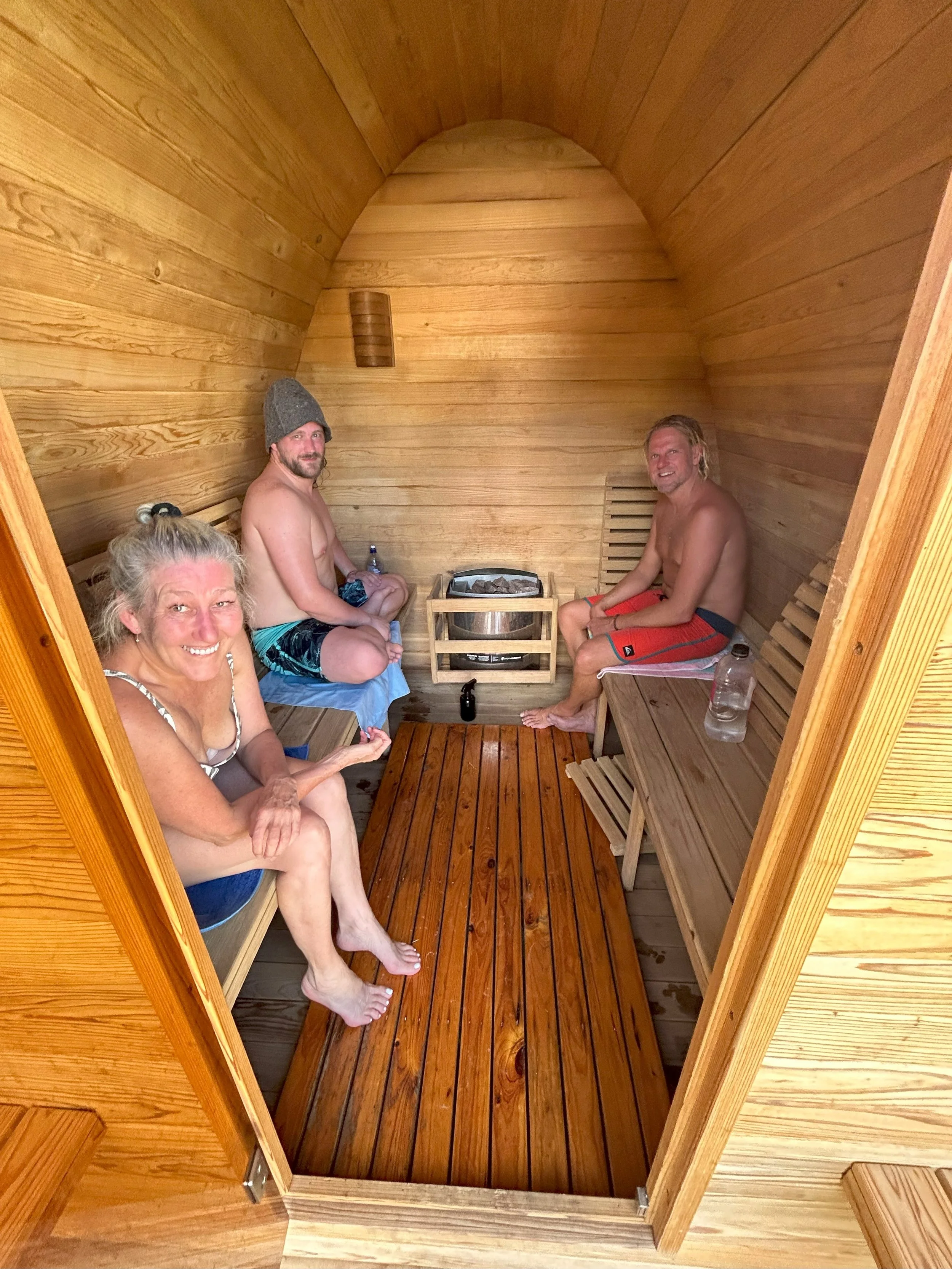


SAUNA?
Benefits of Sauna Therapy
Sauna Therapy and Pine Needle Oil research:
The skin is the body’s largest organ and our interface with the physical world. Through perspiration, it acts as an important vehicle for the elimination of toxins. The skin is often referred to as the ‘third kidney’.
Saunas assist greatly in the elimination of toxins. In the process the skin is cleaned of surface bacteria and dead skin cells – something that cannot be done by just taking a shower or bath. The sauna also cleans the capillaries, resulting in vastly improved skin condition.
Saunas have been used for thousands of years by Scandinavians, Russians, North American Indians and many others.
In Russia and Finland, there is a saying that every day you take a sauna is a day that you are not ageing.
Hippocrates, the founder of Western medicine more than two thousand years ago, said: “Give me the power to create a fever, and I shall cure any disease”.
Although misunderstood as a symptom of disease, fever is actually a part of the body’s natural healing response. During a fever, the functioning of the immune system is stimulated, whilst growth of bacteria and viruses are inhibited. All of us would be aware of the great feeling of cleanliness and well being experienced after a fever has passed through us. Saunas elicit similar responses and are often called ‘artificial fevers’.
Extensive research over many years has shown numerous benefits of saunas, including increased circulation, detoxification and oxygenation of tissues and cells, stimulation of the immune system, reduction of stomach acidity, reduction of cold/flu symptoms, increased lung capacity, relaxation, enhanced quality of sleep and reduced soreness post exercise/injury.
Research has supported the use of saunas for treatment of pain management (including arthritis, fibromyalgia, sports injuries etc), in detoxification programs, weight loss, lowering of blood pressure and stress relief.
Russian and Finnish research has shown the sauna to be an irreplaceable training modality for athletes, reducing recovery time and soreness post exercise/injury, and increasing muscle power and concentration. It also reduces the cold, nervous feeling that causes shivering before competition and that can make athletes prone to injury.
The psychological impacts of the sauna have been shown to be just as significant. After a sauna, feelings of stress, lethargy and tiredness are replaced with a generalized feeling of well-being which includes lightness, energy, relaxation and optimism.
Prior to the late 1980 Olympics, forest biochemists in the former Soviet union developed a pine needle oil derived from the non-water soluble fraction of the paste from Scotch Pine (Pinus sylvestris) and European Spruce (Picus abies) needles combined with the oil fraction isolated in Siberian Fir (Abies siberica) needle extraction. Their research found that it significantly enhanced the therapeutic benefits of sauna therapy including elimination of lactic acid and reduced recovery time and soreness post competition, training and injuries.
The oil is a natural complex containing many biologically active substances including vitamin E, carotenoids, phytosterols, terpenoids, polyprenols and pure conifer essential oil. It is rubbed on to the torso and any sore or injured areas during a sauna
Research in Russia found that the positive, therapeutic effects of saunas were significantly enhanced when used in conjunction with this oil based conifer needle extract.
This research compared those who used saunas alone with those who complement their sauna with the needle extract. Specifically it was found that far greater than using a sauna alone, using Pine needle oil in conjunction with a sauna:
Increased muscle concentration and power.
As a result it helps replace areas of dimply ‘cellulite’ skin with a toned, muscular look.
Increased sweating.
Improved detoxification and elimination of toxins, lactic acid and other metabolic wastes.
Improved detoxification and elimination of heavy metals.
Reduced soreness post exercise and injury, and speed up recovery time.
Activation the immune system and increased antimicrobial activity both in the skin and further internally.
Increasing adipose tissue in the skin, making the skin softer, more hydrated and younger looking.
Increase the skin’s resistance to irritants.
Leading to a generalized feeling of well being.
Promoting a great night’s sleep.
Assistance with recovery from jet lag.

